🔍 Executive Summary
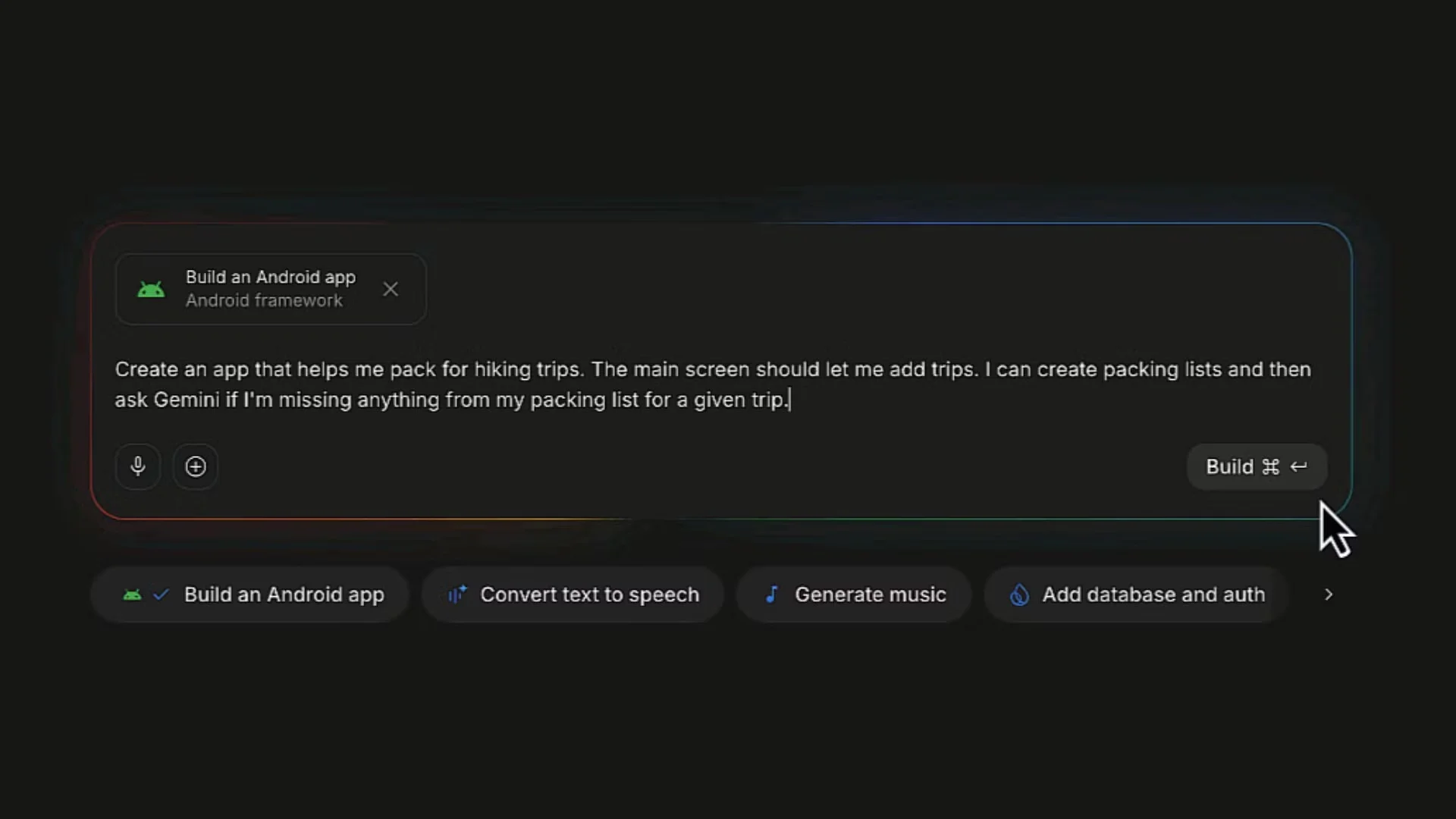
- Google has fundamentally disrupted the mobile development lifecycle by integrating Gemini into AI Studio, allowing for the generation of complete, native Android applications through natural language prompts.
Strategic Deep-Dive
The integration of prompt-to-app capabilities within Google AI Studio marks a watershed moment for the Android ecosystem. By leveraging the advanced reasoning capabilities of the Gemini Large Language Model (LLM), Google is effectively abstracting away the ‘boilerplate’ barrier that has historically hindered rapid mobile development. Traditionally, creating a native Android application required an intimate knowledge of the Android SDK, Gradle build systems, and the intricate nuances of Kotlin or Java.
Now, the workflow begins with a descriptive intent. This shift from imperative programming—where a developer meticulously dictates every step—to a declarative, AI-driven model allows anyone with a logical concept to manifest it as a functional APK.
Technically, this process involves Gemini interpreting natural language and mapping it to a structured set of Android components. It handles everything from the orchestration of the Android Manifest to the generation of modern UI code using Jetpack Compose. For instance, if a user prompts for a real-time weather tracking application, Gemini does not just suggest a code snippet; it structures the entire project architecture, including state management, API integration, and standard Material Design components.
This level of automation ensures that the resulting code is not just functional but also adheres to Google’s current best practices for performance and accessibility. However, it is important to note the present limitations. While Gemini excels at scaffolding and functional prototyping, complex enterprise requirements—such as legacy system integration, bespoke security protocols, or intricate multi-module builds—still require the oversight of a senior engineer.
The implications for the software industry are profound. We are witnessing the democratization of app creation, where the ’time-to-market’ for a startup idea is reduced from months to minutes. For established developers, this tool serves as a force multiplier, automating the tedious aspects of UI layout and repetitive logic, thereby allowing them to focus on high-level system architecture and unique user value.
Furthermore, this transition indicates that the next generation of developer tools will be characterized by ‘context-awareness,’ where the AI understands the intent behind the code rather than just the syntax. As Gemini continues to evolve, the distinction between ‘coding’ and ‘orchestrating’ will blur, fundamentally reshaping the talent landscape of the global tech economy. This is not the end of the software engineer; it is the birth of the AI-augmented architect.