🔍 Executive Summary
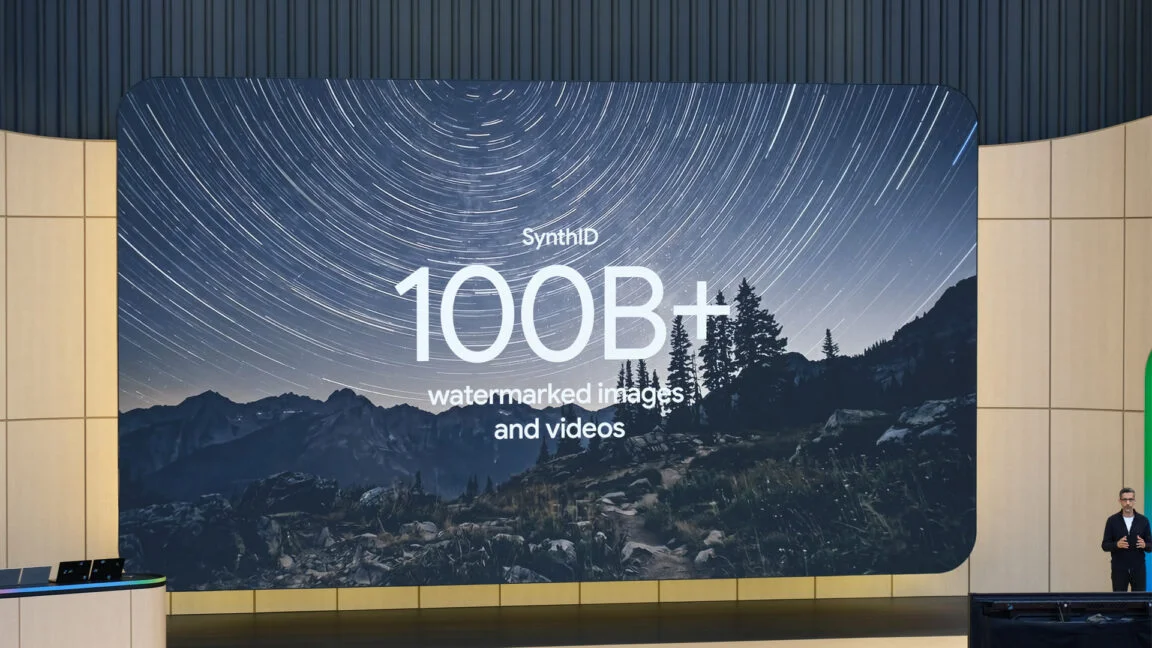
- In a rare show of unity, OpenAI and Nvidia have adopted Google's SynthID watermarking technology, creating a unified technical front to combat the rising tide of AI-generated misinformation and deepfakes.
Strategic Deep-Dive
The digital landscape is currently facing an existential crisis: as generative AI reaches human-level fidelity, the ability to distinguish between reality and synthetic fabrication is eroding. In response, a surprising alliance has formed between the industry’s fiercest rivals. Google’s SynthID, a cutting-edge watermarking technology, has officially been adopted by OpenAI and Nvidia.
This move represents a tectonic shift in AI governance, moving from proprietary safety silos to a unified, industry-wide transparency standard. For the first time, the companies responsible for the world’s most powerful LLMs and the hardware that runs them are coalescing around a single technical solution to authenticate digital content.
From a technical perspective, SynthID is a marvel of data architecture. Unlike traditional metadata-based watermarks that can be easily stripped away, SynthID embeds its signature directly into the data itself. For images, this involves subtle pixel manipulations that are invisible to the naked eye but mathematically detectable by specialized decoders.
For text, it utilizes statistical probability patterns in word selection that function as a digital fingerprint. The adoption by Nvidia is particularly critical; by integrating SynthID at the silicon and driver level, the process of watermarking becomes ‘Secure by Default’ during the inference phase. This ensures that content generated on Nvidia-powered clusters carries a mark of origin that is incredibly difficult to excise without destroying the content’s integrity.
However, as a Senior Investigative Journalist, one must look beyond the press releases to the strategic motivations. This alliance is as much about pre-empting regulation as it is about public safety. With the European Union’s AI Act and various US executive orders looming, the Big Three (Google, OpenAI, Nvidia) are attempting to demonstrate that the industry can self-regulate.
By standardizing on SynthID, they are creating a technical moat that smaller, less-regulated competitors may struggle to cross. It also provides a centralized mechanism for content authentication, which—while beneficial for stopping deepfakes—raises questions about who controls the ’truth’ in a digital ecosystem. If only a few companies have the ‘keys’ to the decoders, does that centralize too much power over digital discourse?
Furthermore, the technical limitations of watermarking must be acknowledged. While SynthID is resilient against compression and cropping, it is not invincible. Adversarial attacks designed to inject noise or re-encode synthetic media could eventually bypass these safeguards.
The ‘cat-and-mouse’ game between watermarking and de-watermarking will likely become a new front in the cybersecurity war. Moreover, the effectiveness of SynthID depends entirely on its ubiquity. If social media platforms and browsers do not integrate the detection tools, the watermark remains a hidden, useless signal.
Therefore, this partnership with OpenAI and Nvidia is the necessary first step in building the scale required for SynthID to move from a laboratory experiment to a global digital seal of authenticity. It is a performative safety measure in part, but it is also the most robust defense we currently have against the weaponization of synthetic media.