🔍 Executive Summary
- Sarthak Vaish, an associate partner at McKinsey & Company, provided a sobering assessment of the robotics industry during the 5th Mobis Mobility Day in Sunnyvale. Despite an optimistic long-term valuation that sees the global robotics market reaching $400 billion by 2040, the industry is currently grappling with what Vaish describes as 'pilot purgatory.' This phenomenon occurs when organizations successfully launch initial pilot programs or proof-of-concepts for robotic systems but fail to scale them into full-scale industrial operations. According to the McKinsey report, the primary bottlenec...
Strategic Deep-Dive
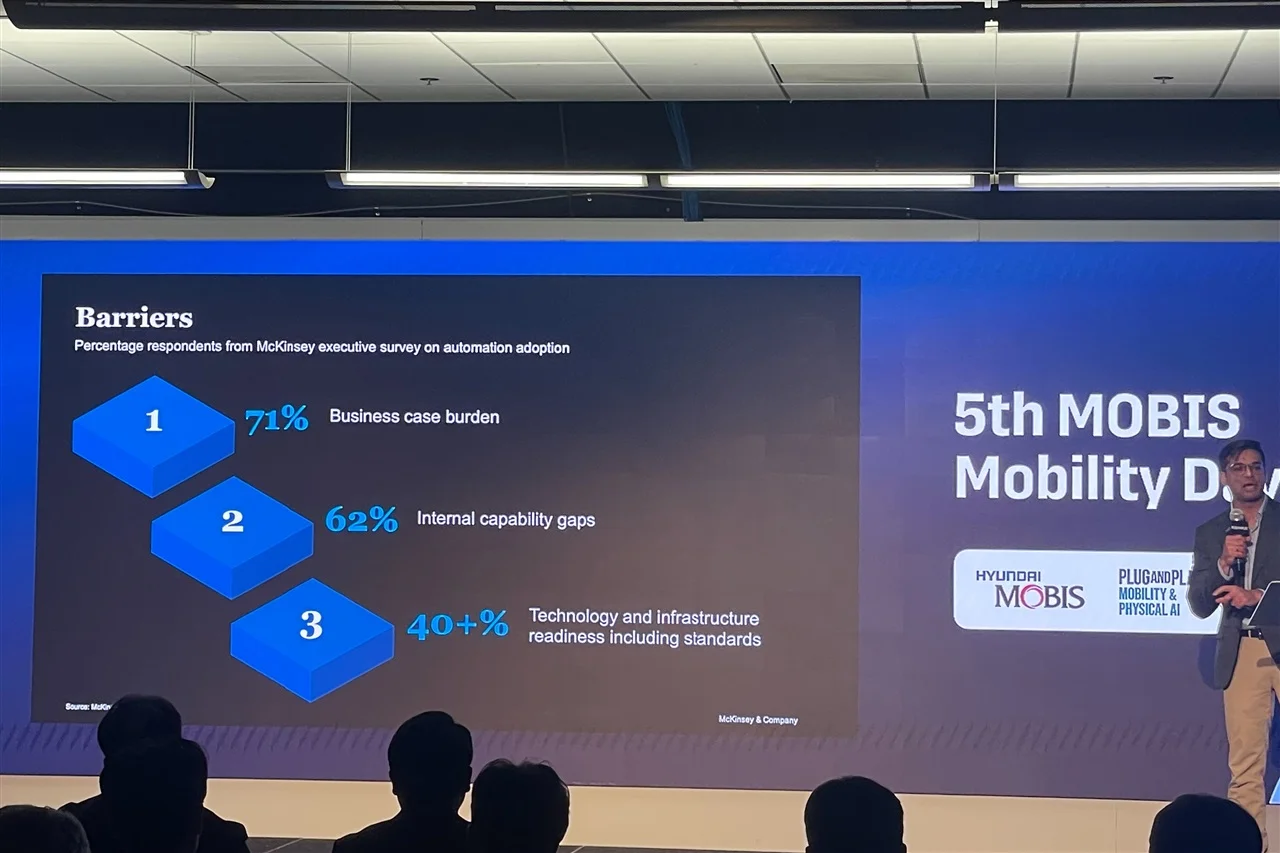
Sarthak Vaish, an associate partner at McKinsey & Company, provided a sobering assessment of the robotics industry during the 5th Mobis Mobility Day in Sunnyvale. Despite an optimistic long-term valuation that sees the global robotics market reaching $400 billion by 2040, the industry is currently grappling with what Vaish describes as ‘pilot purgatory.’ This phenomenon occurs when organizations successfully launch initial pilot programs or proof-of-concepts for robotic systems but fail to scale them into full-scale industrial operations. According to the McKinsey report, the primary bottleneck is no longer the hardware itself; humanoid and advanced industrial robot technology has reached a level of technical readiness where it can theoretically perform a wide array of complex tasks in manufacturing, logistics, and healthcare.
Instead, the failure to advance lies within the organizations themselves, which lack the necessary structural flexibility, digital infrastructure, and operational workflows to integrate advanced robotics effectively. The gap between technical capability and industrial adoption remains the single greatest challenge to achieving the projected market growth. Vaish emphasized that while hardware developers are making rapid strides in dexterity, sensing, and battery life, the value chain is broken at the point of deployment.
For the $400 billion outlook to become a reality, companies must move beyond the novelty of robotic pilots and address the hard task of organizational transformation. This includes redesigning jobs to accommodate human-robot collaboration, upgrading backend IT systems to handle real-time robotic telemetry data, and fostering a corporate culture that can adapt to automated systems.
McKinsey’s analysis suggests that the next decade will be defined not by a lack of robotic ingenuity, but by the speed at which traditional industries can overhaul their legacy processes. ‘Pilot purgatory’ is often the result of companies treating robotics as a standalone hardware purchase rather than a fundamental shift in business logic. To bridge this gap, McKinsey advises businesses to invest in ‘organizational readiness,’ which involves training staff for new roles and ensuring that the digital twin of the factory or warehouse is compatible with robotic autonomy.
The report serves as a clarion call for businesses to stop viewing robotics through a purely technical lens and start treating it as a strategic overhaul of how work is organized and performed.
Furthermore, the study points out that the robotics manufacturers themselves must evolve. To escape the pilot phase, vendors need to offer more than just machines; they must provide comprehensive integration services, software platforms for fleet management, and clear ROI metrics that appeal to C-suite executives. Until the disconnect between hardware capability and organizational capacity is resolved through systemic changes in corporate strategy and execution, the full economic potential of the robotics revolution will remain untapped.
The $400 billion figure is a possibility, but it is contingent on the industrial world’s ability to move past the ‘purgatory’ of isolated testing into the heaven of full-scale, data-driven automation.