🔍 Executive Summary
- As high-level diplomacy intersects with AI hardware distribution, the roles of Jensen Huang and Elon Musk have become central to the survival of Nvidia's H200 in the Chinese market, representing the high-stakes balancing act between national security and global commerce.
Strategic Deep-Dive
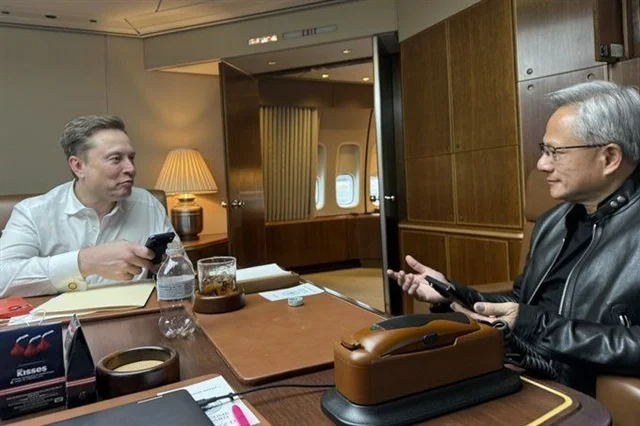
The intersection of high-stakes geopolitics and cutting-edge artificial intelligence hardware has reached a fever pitch following US President Donald Trump’s high-profile delegation to China. This mission, which included 17 of the most influential business leaders in America, placed Nvidia’s Jensen Huang and Tesla’s Elon Musk at the epicenter of a complex trade narrative. At the heart of this discussion is the Nvidia H200 Tensor Core GPU, a piece of hardware that has become a symbol of the struggle between national security interests and the realities of global market interdependence.
The H200, which features advanced HBM3e (High Bandwidth Memory 3e) technology, represents the pinnacle of AI acceleration currently available to major cloud service providers. In China, the chip is increasingly viewed through the lens of the ’last available high-end silicon,’ a narrative suggesting that if future sanctions tighten, the H200 might be the final tier of US-designed compute power accessible to Beijing before domestic alternatives must suffice.
For Jensen Huang, the strategic challenge is two-fold: maintaining compliance with stringent US export controls while preventing Chinese customers from permanently migrating to domestic architectures like those proposed by Biren Technology or Moore Threads. The H200’s superior memory bandwidth and flops performance provide a compelling reason for Chinese tech giants like Tencent and Alibaba to remain within the CUDA ecosystem. However, the ’last chip’ narrative creates a sense of urgency and volatility in the supply chain.
During the visit, the presence of 17 business leaders underscored a collective corporate effort to push back against a complete decoupling of the tech sectors. These executives are leveraging their companies’ dominance in the hardware stack to act as informal diplomats, seeking a middle ground where critical technology can still be traded without compromising sovereign security protocols.
Elon Musk’s role in this ecosystem is equally pivotal. As Tesla aims to roll out its Full Self-Driving (FSD) software in China, the demand for localized data processing and AI training clusters grows. Tesla’s reliance on Nvidia hardware to train its neural networks creates a cross-industry synergy that ties the automotive and semiconductor sectors together in the eyes of Chinese regulators.
The delegation’s efforts suggest that the AI supply chain is undergoing a profound restructuring, where hardware availability is increasingly dictated by corporate lobbying and geopolitical maneuvering rather than simple supply and demand.
Ultimately, the H200 stands as the most critical asset in this high-wire act. Its technical specifications make it indispensable for Large Language Model (LLM) training, yet its origin makes it a target for regulatory scrutiny. As Huang and Musk navigate the halls of power in Beijing and Washington, they are redefining the role of the tech CEO as a geopolitical strategist.
The ’last chip’ saga highlights the fragility of the global AI hardware landscape and the reality that the future of silicon distribution will be determined by the ability of these leaders to bridge the widening gap between the world’s two largest economies. The narrative is no longer just about flops; it is about the survival of a globalized tech order in an era of digital nationalism.