🔍 Executive Summary
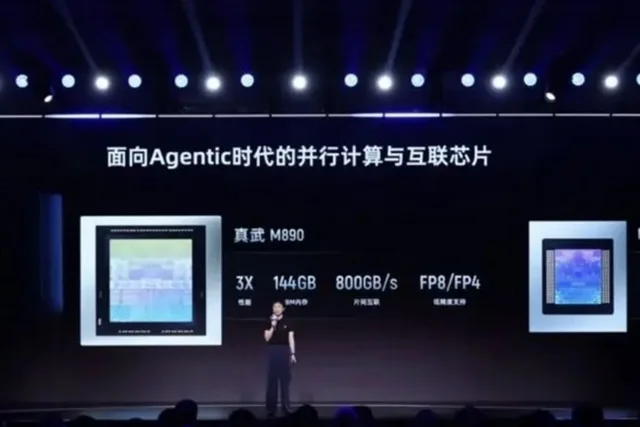
- Alibaba Cloud's T-Head subsidiary launches Zhenwu M890, a unified AI training and inference accelerator.
- The silicon signals a strategic shift toward vertical integration to support autonomous 'Agentic AI' workloads.
Strategic Deep-Dive
The unveiling of the Zhenwu M890 by Alibaba Cloud’s T-Head Semiconductor marks a definitive era of cloud providers transitioning into vertically integrated hardware powerhouses. As of May 2026, the strategic imperative for proprietary silicon has moved from a cost-saving measure to a fundamental requirement for infrastructure survival and competitive differentiation. The Zhenwu M890, designed specifically for both training and inference, addresses the burgeoning demands of the ‘Agentic AI’ landscape—a paradigm where AI models move beyond static responses to proactive, autonomous task execution and complex decision-making loops.
Technically, Agentic AI workloads differ significantly from standard LLM inference. They require sustained, low-latency reasoning chains and rapid context-switching as the agent interacts with environment feedback. The M890 architecture addresses these needs through a specialized on-chip interconnect and optimized memory hierarchy designed to minimize the latency of multi-step planning cycles.
By owning the silicon layer, Alibaba can implement hardware-software co-optimization that is impossible with general-purpose GPUs. Specifically, the M890 is tuned to accelerate the attention mechanisms and recursive loops inherent in Alibaba’s proprietary ‘Qwen’ model family, allowing for a ‘super-gap’ in energy efficiency and response speed that third-party vendors cannot match.
Furthermore, the move to full-stack self-sufficiency is a critical hedge against global supply chain volatility. In an environment where access to high-end accelerators is frequently throttled by geopolitical export controls or foundry capacity bottlenecks, having a domestic, in-house pipeline for high-performance AI chips ensures continuous service availability for cloud customers. The M890 represents the maturation of T-Head Semiconductor from experimental designs to production-ready, mission-critical infrastructure.
It allows Alibaba to bypass the ‘merchant silicon tax’ and internalize the value chain of AI production.
Third, the integration of training and inference capabilities into a single silicon platform like the Zhenwu M890 suggests a move toward more dynamic and adaptable AI ecosystems. In the Agentic AI era, models are not just trained once; they must be constantly refined through online learning and fine-tuning. Proprietary silicon allows Alibaba to deploy custom instruction sets that accelerate these hybrid workloads, providing a decisive edge in throughput for next-generation digital workers.
This sovereign cloud strategy ensures that the underlying compute fabric is as intelligent and flexible as the software agents it hosts, insulating Alibaba Cloud from external shocks while defining the future of autonomous digital economies.
Ultimately, the Zhenwu M890 is not just a hardware component; it is the cornerstone of a strategic ‘walled garden’ approach. By controlling the architecture from the transistor level up to the application programming interface (API), Alibaba is positioning itself as the primary architect of the Chinese AI ecosystem, ensuring that the next generation of autonomous agents will be built on a foundation of proprietary, high-performance Chinese silicon.