🔍 Executive Summary
- The global semiconductor landscape is bracing for a seismic shift as China’s premier memory titans, Yangtze Memory Technologies (YMTC) and ChangXin Memory Technologies (CXMT), accelerate their transitions into publicly traded entities. This synchronized capital market strategy marks a pivotal moment in the ongoing US-China tech war. YMTC has officially entered the pre-IPO counseling phase, while CXMT has reactivated its application for the Shanghai Stock Exchange’s STAR Market. These moves represent a strategic maturation of the Chinese memory sector, shifting from reliance on state-led indust...
Strategic Deep-Dive
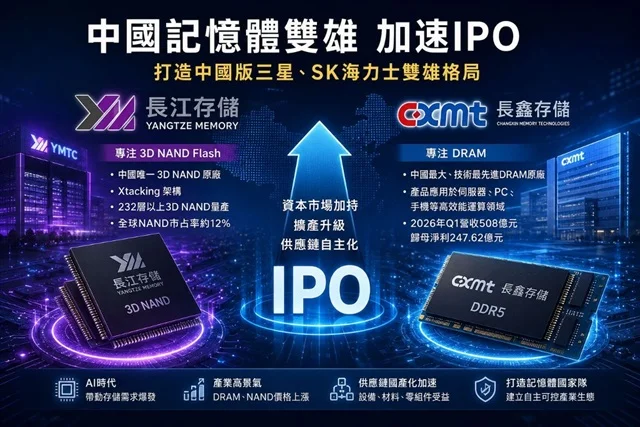
The global semiconductor landscape is bracing for a seismic shift as China’s premier memory titans, Yangtze Memory Technologies (YMTC) and ChangXin Memory Technologies (CXMT), accelerate their transitions into publicly traded entities. This synchronized capital market strategy marks a pivotal moment in the ongoing US-China tech war. YMTC has officially entered the pre-IPO counseling phase, while CXMT has reactivated its application for the Shanghai Stock Exchange’s STAR Market.
These moves represent a strategic maturation of the Chinese memory sector, shifting from reliance on state-led industrial funds to a more sustainable, market-oriented capital structure. This transition is essential for ensuring a consistent flow of capital to maintain an aggressive research and development (R&D) cadence and massive capacity expansion in an increasingly hostile trade environment.
Technically, the financial infusion targets critical architectural milestones that are necessary to maintain parity with Western and South Korean leaders. YMTC is focused on scaling its proprietary Xtacking architecture, which allows for higher bit density and faster I/O speeds by bonding the periphery circuitry and memory cell wafers separately. As YMTC aims for 300-layer and beyond 3D NAND thresholds, the capital from an IPO will be funneled into mitigating the costs associated with localized supply chain development, which has become mandatory due to lithography equipment restrictions.
On the DRAM front, CXMT is looking to secure the necessary ‘dry powder’ to fuel its ambitious High Bandwidth Memory (HBM) roadmap. By professionalizing its corporate governance through a public listing, CXMT seeks to attract global talent and institutional investors, positioning itself as a legitimate alternative to the long-standing DRAM triumvirate of Samsung, SK Hynix, and Micron.
From a market intelligence perspective, the implications for global NAND and DRAM pricing are profound. Should these listings succeed in raising the projected billions in capital, YMTC and CXMT will likely embark on a multi-year Capex binge. This would enable them to reach critical economies of scale, potentially leading to a market flooded with cost-competitive memory components from China.
For established incumbents, this introduces the risk of ‘market bifurcation,’ where standard commodities are dominated by Chinese supply while they are forced to retreat into high-margin, specialized AI memory niches. Furthermore, the strategic necessity of domestic funding reflects China’s broader goal of semiconductor self-reliance. By tapping into the vast liquidity of the Chinese domestic market, these firms are effectively insulation themselves from external financial sanctions.
The success of these IPOs will not only redefine the competitive landscape of the memory industry but also serve as a barometer for China’s ability to sustain its high-tech aspirations in the face of unprecedented geopolitical pressure. This is a long-term play for dominance in the foundational layer of the global digital economy.