🔍 Executive Summary
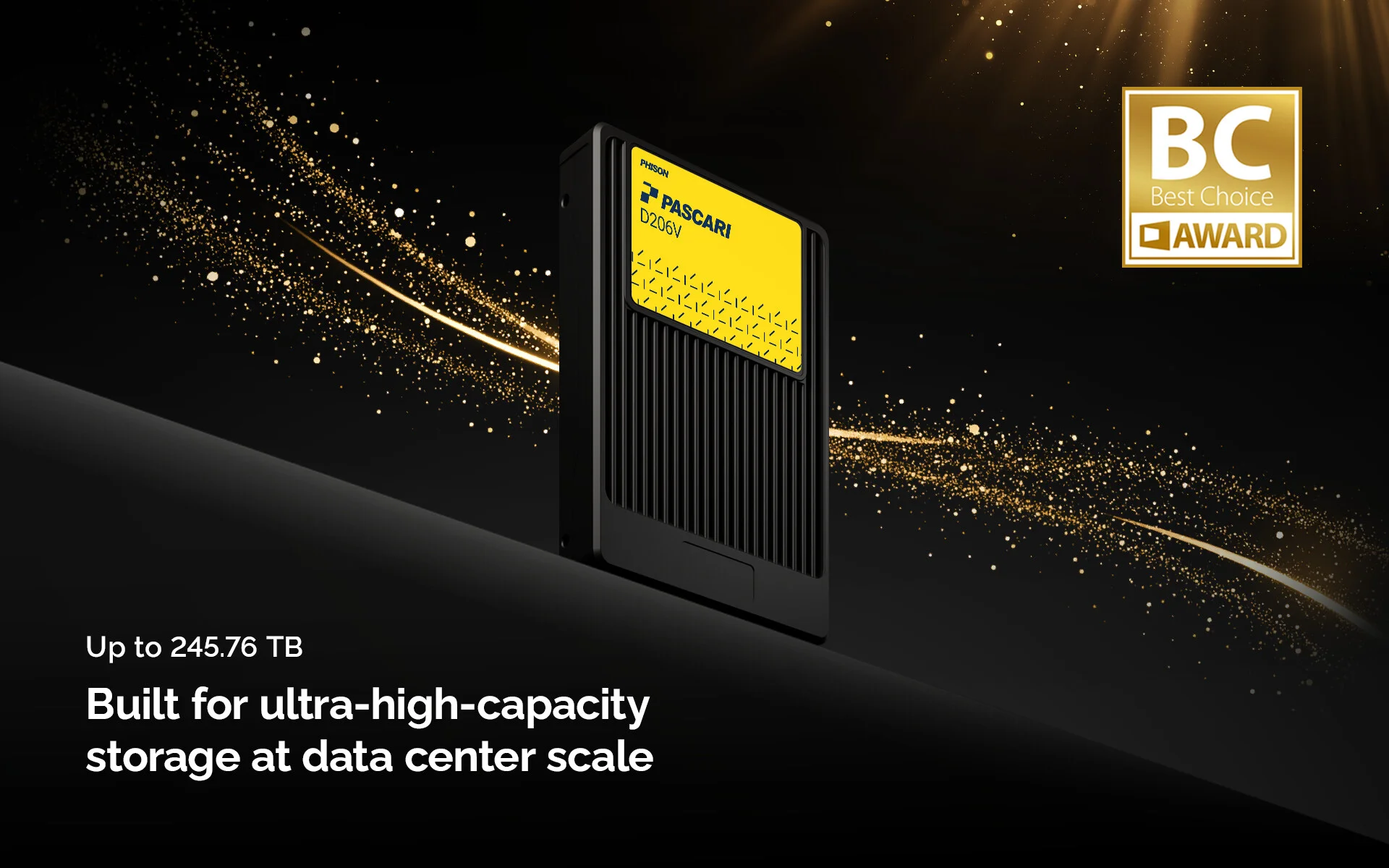
- Phison Electronics has redefined the limits of NAND flash density with the Pascari D206V, a 245.76TB enterprise SSD that secured the COMPUTEX Best Choice Golden Award. By integrating PCIe Gen 5 technology and advanced controller logic, Phison addresses the critical storage bottlenecks in massive-scale AI training environments.
Strategic Deep-Dive
Phison Electronics has officially shattered the ceiling of enterprise storage density with the unveiling of the Pascari D206V PCIe Gen 5 data center SSD. Capturing the prestigious COMPUTEX Best Choice Golden Award, this drive delivers a staggering 245.76 TB of raw capacity in a single unit. From a systems architecture perspective, the D206V represents more than just a victory for vertical NAND stacking; it is a masterclass in controller logic management.
Managing nearly a quarter-petabyte on a single controller requires sophisticated thermal throttling mechanisms and advanced signal processing to mitigate the physical noise inherent in ultra-high-density NAND environments. Phison’s X2 controller architecture is the linchpin here, facilitating the throughput necessary to saturate the PCIe Gen 5 bus while maintaining the reliability metrics required for mission-critical enterprise workloads.
The D206V is specifically engineered for the ‘AI era,’ where data ingestion rates and model checkpointing demand localized high-speed storage that can keep pace with GPU clusters. One of the most significant technical inclusions is support for Zoned Namespaces (ZNS) and Flexible Data Placement (FDP). These features allow the host system to align data placement with the physical structure of the NAND, drastically reducing Write Amplification Factor (WAF) and ensuring that performance does not degrade as the drive approaches full capacity—a common pitfall for high-density drives.
By optimizing the internal garbage collection processes, Phison has maximized the IOPS-per-watt efficiency, making it an ideal candidate for liquid-cooled or high-density air-cooled racks where every watt counts toward the Total Cost of Ownership (TCO).
Furthermore, the impact on data center floor space cannot be overstated. As AI training facilities struggle with power density and physical footprint limits, the ability to consolidate storage from dozens of lower-capacity drives into a handful of D206V units allows for a radical rethink of rack configurations. This consolidation simplifies the networking fabric, reducing the number of NVMe-oF (NVMe over Fabrics) endpoints and lowering the complexity of the storage switch architecture.
Phison’s trajectory suggests a future where storage is no longer a peripheral bottleneck but a high-performance integrated tier that matches the velocity of modern H100 or Rubin-class GPU clusters. This breakthrough positions Phison as a primary architect of the next-generation AI data center, moving the needle from individual component provision to full-scale infrastructure enablement. As the industry moves toward petabyte-scale individual drives, Phison’s early leadership in the 240TB+ range provides them with a multi-year head start in refining the firmware and error-correction protocols necessary to manage such vast amounts of data reliably.