🔍 Executive Summary
- Quiq’s expansion into voice AI signifies a major milestone for enterprise generative AI, marking the transition from experimental pilot programs to full-scale, real-time production deployments in customer experience.
Strategic Deep-Dive
The formal launch of Quiq’s voice AI agent platform marks a pivotal transition in the generative AI market: the movement from speculative pilot programs to large-scale, mission-critical production deployments. For the past two years, many enterprises have experimented with Large Language Models (LLMs) in sandboxed environments. However, Quiq’s expansion into real-time voice interaction signifies that the technology has reached a level of maturity where it can be trusted to handle direct customer interactions in high-stakes environments.
This evolution is centered on the concept of ‘resolution, not just answers,’ representing a shift from informational bots to functional, agentic systems.
Technical Architecture: Orchestrating the Voice Pipeline
Deploying voice AI at an enterprise scale involves overcoming significant technical hurdles, primarily centered on latency and multimodal orchestration. A seamless voice interaction requires the near-instantaneous synchronization of Speech-to-Text (STT), LLM-based reasoning, and Text-to-Speech (TTS) engines. In a customer service context, any delay exceeding 200-300 milliseconds disrupts the conversational flow and diminishes the perceived quality of the service.
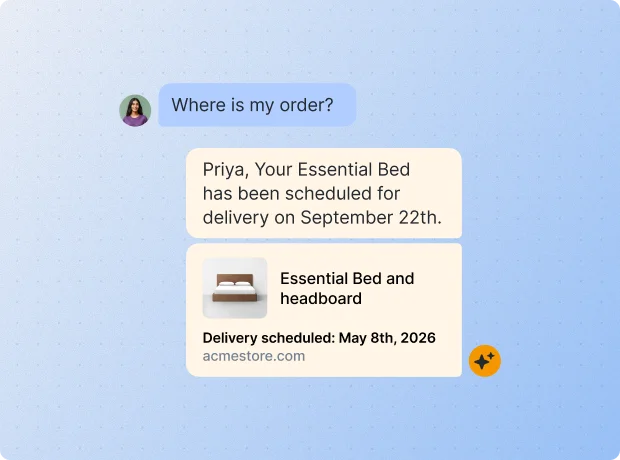
Quiq’s architecture addresses this by utilizing a high-performance communication stack designed for low-latency delivery. Furthermore, the platform enables a fluid omni-channel experience, allowing a user to start a conversation via voice and transition to a messaging interface—where the AI can share visual documents or secure payment links—without losing the session’s context. This level of cross-channel persistence is essential for modern CX (Customer Experience) strategies.
Market Impact: The ROI of Production AI
As enterprises face increasing pressure to show a return on their AI investments, platforms like Quiq are focusing on tangible metrics such as First Contact Resolution (FCR) and cost-per-interaction reduction. By automating complex voice-based tasks that were previously the sole domain of human agents—such as order modification, technical troubleshooting, and billing disputes—Quiq is enabling companies to scale their support capabilities without a commensurate increase in headcount. This shift is particularly impactful in industries like retail and telecommunications, where call volumes are high and the demand for 24/7 support is constant.
The move into production signals that generative AI is no longer a ‘science project’ but a core driver of operational efficiency.
Strategic Outlook: The Rise of Autonomous CX
The success of Quiq’s voice platform points toward a future where customer service is primarily driven by autonomous, voice-capable agents. As these agents become more sophisticated, they will move from simple task execution to predictive service, anticipating customer needs based on history and context. For the broader market, the ‘Quiq moment’ demonstrates that the technical infrastructure for real-time voice AI has stabilized.
The competition will now shift from who can build the best model to who can provide the most reliable, secure, and integrated agentic experience. In the era of production AI, the ability to deliver human-like empathy combined with robotic precision will be the ultimate differentiator for enterprise CX platforms.